our-blog, Startup

The Prescriptions for Selling Vapes Online

The legal prescriptions for selling vapes online aren’t as simple as some extra checkout buttons for your customer to press. Because vapes (or electronic nicotine delivery systems, “ENDS”) are regulated under U.S. law, online retailers must follow strict compliance steps — and consumers must meet certain legal requirements.

Under the federal Tobacco 21 (T21) law, it is illegal to sell any tobacco product — including e-cigarettes and nicotine-containing vapes — to anyone under 21 years old. Retailers must verify age using a government-issued photo ID. The FDA requires retailers to check photo IDs for anyone under 30 who attempts to buy regulated products, as of September 30, 2024.

Identity Verification

Since T21, vape stores have created methods to ensure customers are over 21. However, online vape stores must go beyond a simple “I am over 21” checkbox. The legal prescriptions for selling vapes online include federal laws. Businesses often use third-party age verification services in order to ensure compliance. These services compare customer information (name, date of birth, address) with public or private databases before completing a sale.

After verifying, retailers also need to keep records of every transaction’s age check and ID verification. These logs may be subject to inspection by regulators. All in all, it is possible to sell vapes online; however, this business comes with many regulations to note.

Selling Vapes Online: Delivery Requirements

Selling vapes legally online requires compliance with the PACT Act. Online vape sellers are required to ensure that a 21+ adult signature is obtained upon delivery. The person receiving the package typically has to show a valid ID at delivery time. Because of these requirements, many vape retailers use specialized shipping services that are compliant with the PACT Act.

Blue line-art illustration of three vape devices displayed on a computer monitor, representing online vape product listings.
Sellers need to consider many laws and regulations from the T21 to the PACT Act and more.

Product Authorization

Not all vape products are equal in the eyes of regulators. The FDA oversees the sale, manufacturing, labeling, and importation of ENDS products. The FDA must authorize products through pre-market review before companies can legally sell them. Retailers who mix or modify e-liquids (e.g., custom flavors) may fall under FDA manufacturing rules, which impose additional regulatory burdens.

Additionally, online vape stores selling across multiple states must consider various state regulations in order to ensure order compliance. Common state regulations include excise taxes and e-juice flavor bans. For example, since Massachusetts has a complete flavor ban, online vape retailers can’t ship strawberry-flavored vapes to customers in this state.

Vape Business Responsibilities

As a vape business selling online, it is important to ensure that your website includes functions that ensure regulatory compliance, like age verification checks and PACT Act delivery compliance. FutureEcom provides a platform that uses AI to confirm age verification. PACT Act compliance, order compliance, and more. Learn more on our website.

Read More
our-blog

Regulatory Requirements: A Strong Guide to ENDS Laws

Introduction

Selling e-liquid (nicotine-containing e-juice / vape juice) online in the United States is legally complicated: federal rules set a baseline, but states and localities add layers of licensing, taxes, flavor or product bans, and shipping restrictions. This article will use the acronym ENDS in reference to Electronic Nicotine Delivery Systems. The guide below summarizes the major E-liquid regulatory requirements, including common state-level variations and federal laws.

Federal Regulatory Requirements

Firstly, the federal e-liquid regulatory requirement is T21. A federal law raised the minimum legal age to buy tobacco products- including e-cigarettes and e-liquid- from 18 to 21. It became effective on December 20, 2019, and applies to all in-person and online sales.

Seccondly, E-liquid regulatory requirement is that Amendments to the Prevent All Cigarette Trafficking (PACT) Act extend to remote businesses selling e-cigarettes and nicotine products. These regulatory requirements include verifying the age of buyers, complying with state and local licensing, and excise tax and more. The PACT Act was enacted with the intention of reducing tobacco use among Americans. To reduce tobacco use in certain communities, the PACT Act requires online E-liquid businesses to abide by local sales policies. This means that businesses can’t sell to customers in states that have banned E-liquid products.

The last e-liquid regulatory requirement has to do with shipping carriers. Mailing and carriage of e-cigarette products is restricted. USPS and many carriers impose specific rules and, in some contexts, ban the mailing of certain e-cigarette products. Carriers also require an adult signature on delivery and ID verification when shipping tobacco. Always check the carrier’s current policy before shipping your products with them.

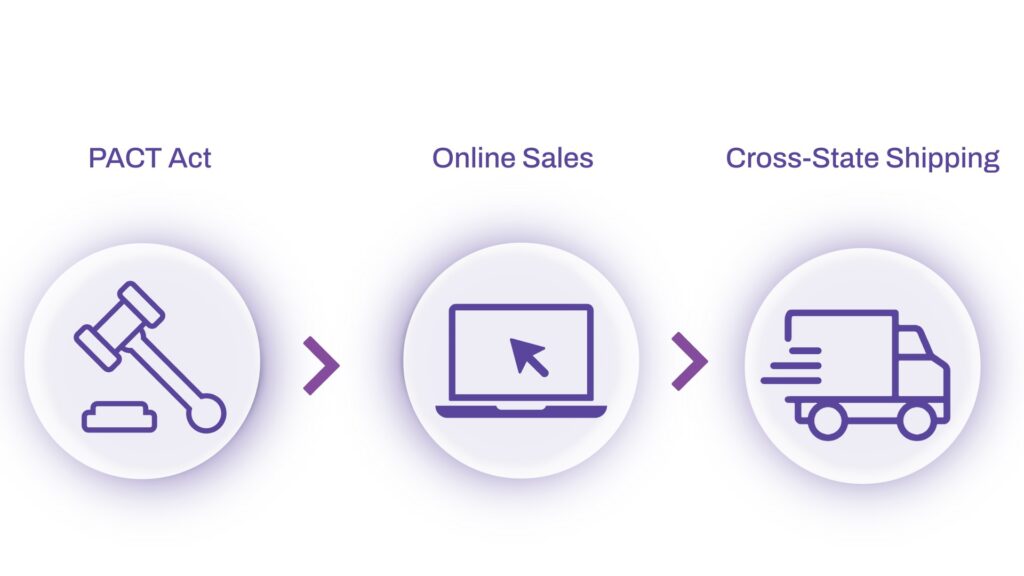
Graphic showing PACT Act compliance, online sales, and cross-state shipping for regulated e-commerce businesses.

State-Varied Regulatory Requirements

There are regulatory requirements regarding ENDS products, and each state takes its own stance based on the issues of its constituents. E-liquid may be subject to state excise taxes on tobacco and ENDS products. Some states require tax stamps or prepaid tax reporting for shipped products. Under the PACT Act, sellers must comply with state tax rules for remote sales. California is among the states that require excise taxes.

Additionally, all online vape businesses need licenses. Many states require tobacco vendor licences for anyone selling nicotine products online. Before selling in multiple states, you may need multiple state licenses.

Also, specific vape items face state-wide regulatory requirements. A few states have restricted or banned disposable flavored pods, certain nicotine concentrations, or device types. For example, California and New York have prohibited the sale of most flavored products, with a few exceptions, while New Jersey has banned all flavored tobacco products. Check the law where the customer is located.

Conclusion

Navigating the regulatory landscape as an online vape business is a complex and demanding task. FutureEcom provides a platform specifically for regulated businesses like yours. Does migrating sound too overwhelming and costly? We can migrate your website for you, or plug into your existing one. Learn more about how FutureEcom can help your regulated business.

Written by Arielle Edberg from FutureEcom

Read More