our-blog, Startup

The Prescriptions for Selling Vapes Online

The legal prescriptions for selling vapes online aren’t as simple as some extra checkout buttons for your customer to press. Because vapes (or electronic nicotine delivery systems, “ENDS”) are regulated under U.S. law, online retailers must follow strict compliance steps — and consumers must meet certain legal requirements.

Under the federal Tobacco 21 (T21) law, it is illegal to sell any tobacco product — including e-cigarettes and nicotine-containing vapes — to anyone under 21 years old. Retailers must verify age using a government-issued photo ID. The FDA requires retailers to check photo IDs for anyone under 30 who attempts to buy regulated products, as of September 30, 2024.

Identity Verification

Since T21, vape stores have created methods to ensure customers are over 21. However, online vape stores must go beyond a simple “I am over 21” checkbox. The legal prescriptions for selling vapes online include federal laws. Businesses often use third-party age verification services in order to ensure compliance. These services compare customer information (name, date of birth, address) with public or private databases before completing a sale.

After verifying, retailers also need to keep records of every transaction’s age check and ID verification. These logs may be subject to inspection by regulators. All in all, it is possible to sell vapes online; however, this business comes with many regulations to note.

Selling Vapes Online: Delivery Requirements

Selling vapes legally online requires compliance with the PACT Act. Online vape sellers are required to ensure that a 21+ adult signature is obtained upon delivery. The person receiving the package typically has to show a valid ID at delivery time. Because of these requirements, many vape retailers use specialized shipping services that are compliant with the PACT Act.

Blue line-art illustration of three vape devices displayed on a computer monitor, representing online vape product listings.
Sellers need to consider many laws and regulations from the T21 to the PACT Act and more.

Product Authorization

Not all vape products are equal in the eyes of regulators. The FDA oversees the sale, manufacturing, labeling, and importation of ENDS products. The FDA must authorize products through pre-market review before companies can legally sell them. Retailers who mix or modify e-liquids (e.g., custom flavors) may fall under FDA manufacturing rules, which impose additional regulatory burdens.

Additionally, online vape stores selling across multiple states must consider various state regulations in order to ensure order compliance. Common state regulations include excise taxes and e-juice flavor bans. For example, since Massachusetts has a complete flavor ban, online vape retailers can’t ship strawberry-flavored vapes to customers in this state.

Vape Business Responsibilities

As a vape business selling online, it is important to ensure that your website includes functions that ensure regulatory compliance, like age verification checks and PACT Act delivery compliance. FutureEcom provides a platform that uses AI to confirm age verification. PACT Act compliance, order compliance, and more. Learn more on our website.

Read More
Development, our-blog

Vape Market Goes Digital: Inside the E-Commerce Boom

Over the past several years, the vape market has rapidly shifted from street-corner to convenience-store sales to online direct-to-consumer channels. Brands and small retailers are increasingly using e-commerce platforms, subscription models, and digital marketing to reach shoppers. Due to competitive pricing, convenience, and a greater selection of goods, consumers are moving online for their vape products and E-cigarette purchases. 18.6% of U.S. respondents in 2023 shared that they purchase E-Cigarettes online or via the “internet.”

Certainly, Vape e-commerce sales are not just beneficial for the customers. E-commerce offers scale, lower overhead and the ability to operate direct-to-consumer (D2C) models like subscription boxes, product bundles, and targeted promotions. Consequently, this increases lifetime value and margin control. The drivers for this move online are connected to General online retail growth. Platforms such as website platforms, payment processors, and subscription tools make building and scaling an online vape business faster and cheaper than opening a physical outlet.

Illustration of vape devices above a laptop screen representing online vape sales and e-commerce growth.
Vape market moves online — digital platforms are now key for vape sales and brand growth.

Explaining the Trend

Regulatory pressure and enforcement are driving this move online. The U.S. Food and Drug Administration and state authorities — have tightened rules around youth access, and flavors. The federal Tobacco-21 (T21) Law raised the minimum age requirement for tobacco purchases. Heightened ID/verification expectations mean online sellers must invest in stricter age-verification and identity checks if they want to keep selling legally. Those that can comply, see vape e-commerce as a controlled channel to distribute authorized products responsibly.

Indeed, E-commerce won’t fully replace physical retail. However, the key growth pathway for a compliant and well-managed sales ecosystem is. The vape market is projected to reach USD $182.84 billion by 2030. Vape E-commerce and FutureEcom will continue to grow alongside this trend. FutureEcom is committed to helping Vape E-commerce businesses thrive despite compliance challenges like changing state regulations across every state. Our REGAffirm AI technology confirms compliance before your order leaves the wearhouse.

Defy Limits. Not Laws.

Written by Arielle Edberg from FutureEcom

Read More
our-blog

Regulatory Requirements: A Strong Guide to ENDS Laws

Introduction

Selling e-liquid (nicotine-containing e-juice / vape juice) online in the United States is legally complicated: federal rules set a baseline, but states and localities add layers of licensing, taxes, flavor or product bans, and shipping restrictions. This article will use the acronym ENDS in reference to Electronic Nicotine Delivery Systems. The guide below summarizes the major E-liquid regulatory requirements, including common state-level variations and federal laws.

Federal Regulatory Requirements

Firstly, the federal e-liquid regulatory requirement is T21. A federal law raised the minimum legal age to buy tobacco products- including e-cigarettes and e-liquid- from 18 to 21. It became effective on December 20, 2019, and applies to all in-person and online sales.

Seccondly, E-liquid regulatory requirement is that Amendments to the Prevent All Cigarette Trafficking (PACT) Act extend to remote businesses selling e-cigarettes and nicotine products. These regulatory requirements include verifying the age of buyers, complying with state and local licensing, and excise tax and more. The PACT Act was enacted with the intention of reducing tobacco use among Americans. To reduce tobacco use in certain communities, the PACT Act requires online E-liquid businesses to abide by local sales policies. This means that businesses can’t sell to customers in states that have banned E-liquid products.

The last e-liquid regulatory requirement has to do with shipping carriers. Mailing and carriage of e-cigarette products is restricted. USPS and many carriers impose specific rules and, in some contexts, ban the mailing of certain e-cigarette products. Carriers also require an adult signature on delivery and ID verification when shipping tobacco. Always check the carrier’s current policy before shipping your products with them.

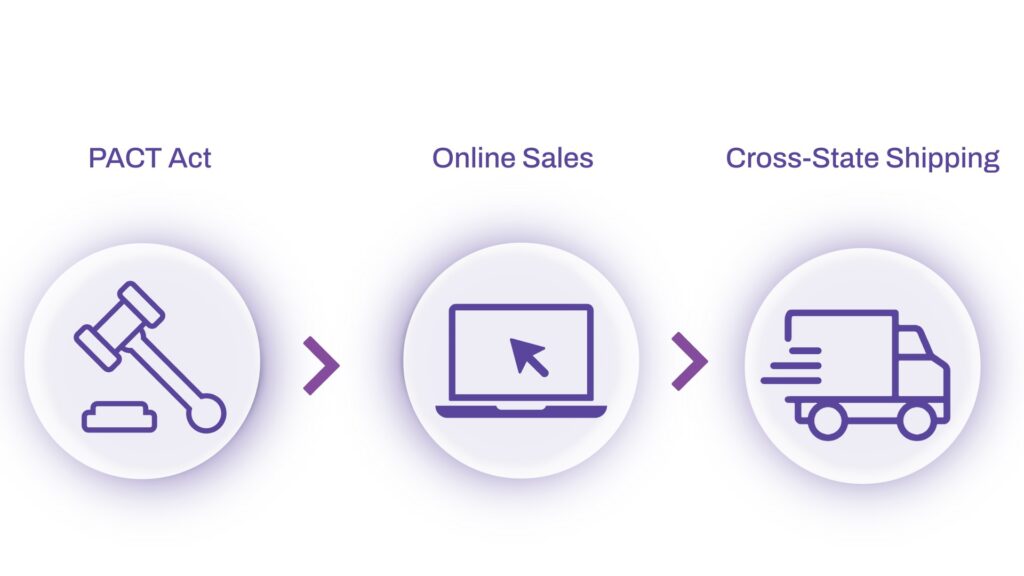
Graphic showing PACT Act compliance, online sales, and cross-state shipping for regulated e-commerce businesses.

State-Varied Regulatory Requirements

There are regulatory requirements regarding ENDS products, and each state takes its own stance based on the issues of its constituents. E-liquid may be subject to state excise taxes on tobacco and ENDS products. Some states require tax stamps or prepaid tax reporting for shipped products. Under the PACT Act, sellers must comply with state tax rules for remote sales. California is among the states that require excise taxes.

Additionally, all online vape businesses need licenses. Many states require tobacco vendor licences for anyone selling nicotine products online. Before selling in multiple states, you may need multiple state licenses.

Also, specific vape items face state-wide regulatory requirements. A few states have restricted or banned disposable flavored pods, certain nicotine concentrations, or device types. For example, California and New York have prohibited the sale of most flavored products, with a few exceptions, while New Jersey has banned all flavored tobacco products. Check the law where the customer is located.

Conclusion

Navigating the regulatory landscape as an online vape business is a complex and demanding task. FutureEcom provides a platform specifically for regulated businesses like yours. Does migrating sound too overwhelming and costly? We can migrate your website for you, or plug into your existing one. Learn more about how FutureEcom can help your regulated business.

Written by Arielle Edberg from FutureEcom

Read More
Black Friday sale tag
our-blog

The Black Friday Online Overflow: A Powerful Lesson

‘Black Friday’ Origins

Consumers debate the origins of Black Friday. Some say the term came from employees skipping work the day after Thanksgiving (see “The Origins of ‘Black Friday’” by Ben Zimmer). Many claim that the term came about as a sign of how important the arguably busiest shopping day of the year is to retailers. The sales helped businesses make a profit and therefore end up “in the black”. So why have some companies stopped doing Black Friday?

FutureEcom Black Friday sales banner promoting e-commerce discounts.

Profit or Crash

Black Friday (along with Cyber Monday) is synonymous with major sales and discounts, and for online sellers, a surge in website traffic. Just as the increase of visitors is a blessing, it can also mean the undoing of an online seller. As more and more users hit the site, the traffic overloads the servers, causing site slowdowns or even crashes. This is not a new phenomenon, yet companies and online sellers still fall victim to this entirely preventable outcome. During last year’s Cyber 5 (Black Friday thru Cyber Monday), major retailers such as Walmart and Office Depot experienced website outages and slow load time.

The result is lost revenue as disappointed shoppers look to other sites to make their Cyber 5 purchases. Consequently, these famous yearly Black Friday sales came to an end for these brands.

Instead of bypassing the opportunity to make a profit, how can online sellers prepare for traffic spikes? By using an e-commerce platform that offers true scaling capability.

Where FutureEcom Comes In

FutureEcom’s advanced architecture was built for traffic spikes. As the number of site visitors increases, so does the power of your online store, so you don’t have to worry about site slowdowns or crashes on your busiest sales days of the year. Other companies have stopped doing Black Friday, but you don’t have to. The FutureEcom platform will literally grow with your business when you need it.

Contact us for more information on how FutureEcom will help your online business succeed.

Read More
What Does Bespoke Ecommerce Mean?
our-blog

Bespoke E-commerce Revealed: The Secrets for Thriving Online

If an e-commerce platform claims to offer bespoke services, what exactly does it mean?

In addition to the wonderful services that the platform offers, there are options for integration and customization. In layman’s terms, this means limitless customization possibilities. This goes for a website’s look and feel, extra features, and working with other tools. Every business has unique needs and requires a platform that works with them to drive conversions and sales.

Bespoke E-commerce Means Limitless Customization

  • Integration: If you have tools that you love using, a customizable platform should integrate these into the programming. The flexibility of the platform should allow for their accommodation. 
  • Design: If you want to bring your own UI to your online platform, endless customization provides you with this possibility. It should integrate the backend engine while accommodating your preferred UI. Build your own front end and break free from the platform’s template. A customizable platform will be flexible! Visit this Wix article for more information about successful website design.
  • Order flow: Each business has its own way of processing orders. Whether you need verification for a special product, want to send a confirmation before shipping, or require a customizable platform. Bespoke E-commerce allows you to integrate your own processes. 

Line art of a computer monitor and smartphone displaying a dollar symbol, symbolizing online sales and digital payment solutions.
Sell smarter online with integrated eCommerce and mobile payment solutions.

Having the ability for endless customization is what a good online platform should offer. No one business is the same, so its platform should not be restricted by rigid parameters. Partnering with a platform that provides bespoke e-commerce is an integral part of setting up your online business. Make sure you choose a platform with a flexible content management system and a responsive design that adjusts for every device. FutureEcom provides many bespoke e-commerce solutions when upgrading and customizing online stores. Read more about their store design solutions and learn more about FutureEcom’s other services.

Read More
Searching for the best E-commerce platforms
our-blog

Unstoppable Store Growth Starts with this Guide

Thinking of starting your own business? Here’s what you need to know before setting up your online store. Mom-and-pop shops and small businesses have suffered profit losses in recent years. Online stores have been a lifesaver. But building an online store isn’t as easy as it seems. Where do you start, and what do you need to know?

How To

Part of establishing your brand name and credibility is having a seamless website that looks good and makes shopping easier.

Surveys show that if a website looks too complicated, or its checkout shopping cart is too glitchy, bounce rates increase. Sales become lost for your business. 

Many elements need to come together to make the checkout, inventory, and shopping experience effortless. 

Whether you’re starting, upgrading, or expanding your online business, you need a platform that gives you powerful customization options. Sometimes, business owners want access to specific tools, features, and workflows that they can carry over to their online store. Their platform needs to accommodate them and expand to allow for more integration.

Line art of a computer monitor and smartphone displaying a dollar symbol, symbolizing online sales and digital payment solutions
Sell smarter online with integrated eCommerce and mobile payment solutions.

Pillars of Store Design

The host needs to therefore have that reflected in the store’s design as well. 

  • Responsive design (a website that works on desktop and mobile devices), 
  • Customizable design (how the button actually looks),
  • Content managed well (including where, how, and what your products look like and how they are placed), 
  • Your site supports language translations, making it available in many languages (a must in today’s globalized e-commerce age).

All these factors are integral for the platform you choose to use to create your online business. 

Necessary Features

Brick-and-mortar stores are hard to manage with their unique complications. Digital versions of the same thing also bog down online stores.

  • A platform for your online store should have flexible products (a seamless way to catalogue a product with various size and color options),
  • Inventory management (a count system built in that lets you know when it’s time to restock your most popular products)
  • An up-sell feature (a menu of related products on display on the page of the original products the customer has chosen)
  • Smart filtering (provide an easy way for a customer to find the product they need)
  • The ability to accommodate extras (e.g., packaging choices).  

In addition to having an excellent system in place to help you manage your business is great. However, the platform must have ways to easily add discounts or special sales campaigns to your online store. 

Once you’ve established what you want, getting started is simple. FutureEcom guarantees to give you the best platform while protecting your data and increasing your sales. 

Now that you’re equipped with a checklist of what you’ll need for your online store, it’s time to get started. 

Read More
our-blog

E-commerce Platform and How to Picking One

These days, brick-and-mortar stores are in decline as sales on E-commerce platforms soar.

The world is shifting from walk-in boutiques to online shopping from the comfort of your own home. The numbers speak for themselves. If you are looking to open your own shop, you should have an online presence to compete effectively.

This article is for those who have done their research and want to move ahead with opening an online store. One of the hardest choices is deciding what e-commerce platform to use.

Read More
our-blog, Technology

Hybrid E-commerce: Our Approved Predictions For Retail In The Future

The internet is abuzz with discussions of how COVID has changed the buying habits of consumers. While some feared that getting used to online shopping meant that people will only be buying online, the reality is that many still have a preference to visit a store and see an item in person before making a purchase. Nevertheless, we can’t ignore the recent upsurge in online stores over the past few years, from 9.7 million stores worldwide in 2019 to over 26 million stores today; and the number of new ecommerce sites continues to grow each year. The new reality is that the future of ecommerce is not just online; it’s a hybrid model that merges the digital and in-store realms. This blog delves into what this future looks like and how businesses can navigate and thrive in the blended retail landscape.

Image of a hybrid between brick and mortar stores and the digital realm illustrating the future of hybrid ecommerce.

Integrating Physical and Digital Experiences for a Hybrid Model

The cornerstone of hybrid ecommerce is the seamless integration of online and offline experiences. Over the past few years, retailers have been adopting newer technologies that blur the line between physical and digital shopping. For instance, virtual fitting rooms and augmented reality (AR) apps allow customers to try products virtually at home. Smart mirrors in physical stores suggest products based on customer preferences. This integration is expected to become more sophisticated, offering highly personalized and immersive shopping experiences.

Data-Driven Personalization

As retailers operate both online and offline, they gather vast amounts of data. This data, when analyzed effectively, can lead to highly personalized shopping experiences. Imagine walking into a store where the sales staff knows your online shopping history and can make personalized recommendations. Or, an online platform suggesting products based on your in-store purchases. The future of hybrid ecommerce lies in harnessing this data to create a uniquely tailored experience for each customer.

Flexible Fulfillment Options

Convenience is key in the future of hybrid ecommerce. Customers want flexibility in how they can get their products. Services like buy online, pick up in-store (BOPIS), and same-day delivery are becoming standard offerings. We’re also seeing the rise of automated pickup stations and smart lockers, which offer customers the convenience of picking up their online purchases at a location of their choice.

Enhanced Customer Support

Hybrid ecommerce also focuses on providing consistent and efficient customer service across all channels. This means integrating customer service platforms so that a potential buyer can send a query online, which can then be answered by an in-store employee. AI-powered chatbots and virtual assistants will play a significant role in offering immediate and personalized customer service. But these can be even better enhanced by routing a call to the nearest store when a personal touch is required.

Technology at the Forefront

Technological advancements will continue to drive the future of hybrid ecommerce. Technologies like blockchain for secure transactions, AI for predictive analytics, and augmented reality for enhanced inventory management will revolutionize the way retailers operate.

Adapting to Changing Consumer Behaviors

The future of hybrid ecommerce will be about staying agile and responsive to changing consumer behaviors. Retailers will need to continually adapt their strategies to meet evolving customer expectations and stay competitive in a rapidly changing market.

Conclusion

Yes, people are still visiting stores! So the future of online shopping is hybrid ecommerce, which is a dynamic, integrated experience. So, for businesses, the key to success in this new retail landscape will be their ability to adapt, innovate, and seamlessly merge their online and offline operations. As technology continues to evolve, so too will the opportunities for retailers to create engaging and efficient shopping experiences that meet the needs of their customers.

Contact us now to learn how we can help bring your business into the hybrid future!

Read More
SAAS VS NO SAAS
our-blog

SAAS VS NO SAAS

SaaS – or Software as a Service – is an industry which is continuously growing, helping business owners in a variety of ways. Google Apps and Office 365 are finding the benefits of using SaaS platforms in the form of  collaboration software, accounting software as well as using it for things like project management and the like. SaaS is also a nifty engine when it comes to ecommerce and has emerged as a useful solution for small retailers who have found the benefits of sites like Bigcommerce, Shopify and Volusion.

In this blog we’ll explore the pros and cons of SaaS as an ecommerce tool and compare it to the different options out there.

Read More